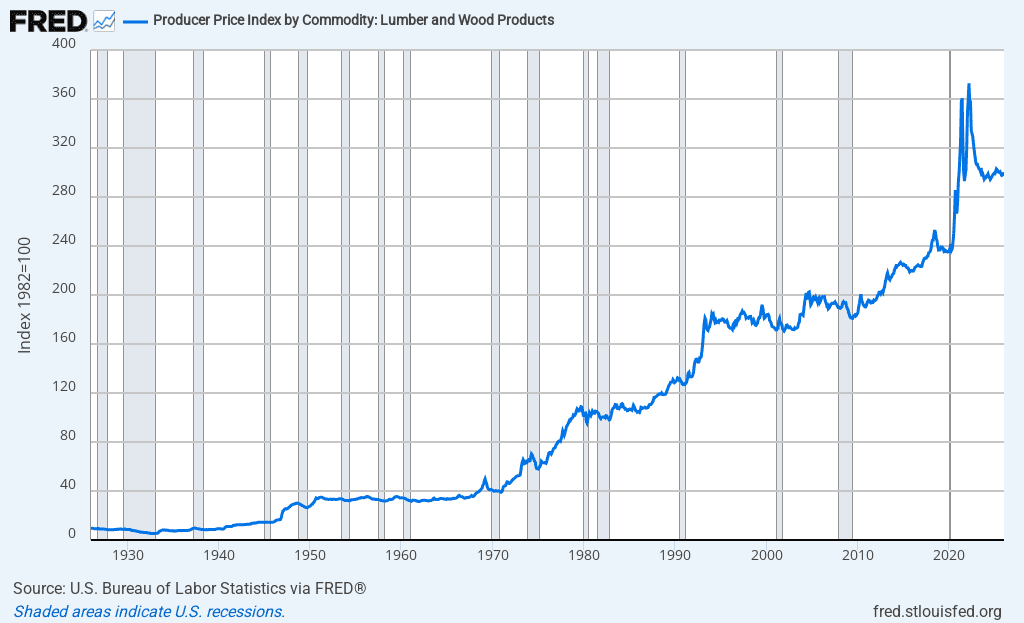
The chart shows a structural long-term uptrend with correction phases after supply-chain shocks. Lumber does not move like speculative assets; it usually re-prices through cycles.
Source: FRED - WPU08.
 RO
ROVerdant News | Market analysis
Timber is a real asset with a steadier adjustment rhythm than many listed assets. First, see the main lumber chart below, then continue with the full comparison against metals, commodities and Magnificent 7 volatility.
Core chart
The chart shows a structural long-term uptrend with correction phases after supply-chain shocks. Lumber does not move like speculative assets; it usually re-prices through cycles.
Source: FRED - WPU08.
SEO analysis
This timber market vs capital market analysis starts from the main lumber price chart (WPU08) and shows that timber behaves like a real-cycle asset: pricing typically adjusts through production, logistics and industrial demand cycles. Listed equities can reprice much faster due to sentiment and liquidity flows. For that reason, stock market vs timber investment is not only a return discussion, but a volatility and resilience discussion as well.
Across commodities, gold remains a monetary stress benchmark with strong upside phases. Palladium and platinum are usually more industrially sensitive and can swing harder. Zinc, aluminum and copper tend to track global manufacturing and infrastructure momentum, while coffee remains more exposed to weather and seasonal shocks. In equities, Magnificent 7 has delivered exceptional gains, but with materially higher volatility and deeper drawdowns.
Portfolio implication: timber can act as a balancing real asset relative to capital markets, especially for long-horizon investors prioritizing durability over short-term momentum. In that framework, timber vs equities comparison supports diversification logic rather than an all-in, single-asset allocation decision.
Cross-asset view
Comparison window: January 2016 - January/February 2026. Metrics include annualized return (CAGRCAGR (Compound Annual Growth Rate): the average yearly growth rate over a period.), annualized volatilityAnnualized Volatility: how strongly prices fluctuate within a year; higher values mean larger swings. and maximum drawdownMaximum Drawdown: the largest peak-to-trough loss observed during the selected period..
| Asset | CAGRCompound Annual Growth Rate: average yearly growth. | Annualized volatilityAnnualized Volatility: yearly scale of price fluctuations. | Max drawdownMaximum Drawdown: deepest peak-to-trough decline. |
|---|---|---|---|
| Lumber (WPU08, FRED) | 3.2% | 8.7% | -21.0% |
| Gold (XAUUSD) | 16.6% | 14.6% | -17.3% |
| Palladium (XPDUSD) | 13.5% | 30.6% | -68.9% |
| Platinum (XPTUSD) | 10.4% | 24.0% | -37.0% |
| Zinc (FRED) | 7.7% | 20.5% | -46.1% |
| Coffee (FRED) | 9.6% | 20.3% | -34.5% |
| Aluminum (FRED) | 7.8% | 15.4% | -39.0% |
| Copper (FRED) | 11.3% | 16.1% | -28.4% |
Key signal: lumber shows a slower return profile than speculative assets, but also lower volatility than most comparable commodities.
Capital markets
| Segment | CAGRCompound Annual Growth Rate: average yearly growth over the period. | Annualized volatilityAnnualized Volatility: amplitude of yearly fluctuations. | Max drawdownMaximum Drawdown: largest decline from a previous peak. |
|---|---|---|---|
| Magnificent 7 (equal-weight basket) | 36.3% | 26.2% | -45.7% |
| Nasdaq 100 | 19.1% | 18.2% | -33.0% |
| S&P 500 | 13.5% | 15.0% | -24.8% |
| Lumber (WPU08) | 3.2% | 8.7% | -21.0% |
Magnificent 7 delivered higher returns, but with materially higher volatility and deeper drawdowns than lumber. In portfolio terms, combining listed equities with real assets can improve resilience across stress cycles.
Verdant conclusion
Core message: timber is usually not a speculative jump asset, but a real-cycle asset. With long-term discipline and sound operations, upside potential remains relevant.
Note: this material is for information and does not represent individualized investment advice.
FAQ
The chart tracks producer-level lumber pricing and helps identify long-term trend behavior, including acceleration and correction phases.
Timber pricing is tied to real production cycles, logistics and commercial contracts, which often reprice more gradually than sentiment-driven listed equities.
Magnificent 7 can deliver stronger upside, but with materially larger swings. Timber often shows a steadier adjustment profile and lower volatility.
Recent data suggests timber may still be below prior cycle peaks while industrial demand continues, supporting medium- to long-term recovery potential.
Timber can be used as a real-asset diversifier alongside equities, offering a different risk profile and exposure to real-economy demand.
Social media
Verdant on Instagram and YouTube
Instagram
View profileVerdant Instagram gallery
A curated stream of our latest visuals from Instagram activity.
YouTube
View channel